

Module 11 🎴 Reading for Yourself Without Bias 🎴
How to Stay Clear When the Cards Hit Close to Home

Welcome back, Magickal One. ✨
Let’s talk about one of the most common struggles in tarot — one that barely anyone mentions out loud because it feels a little embarrassing to admit.
Reading for yourself. 🎴
Specifically: reading for yourself when the question really matters. When it’s about your relationship, your career, your health, your future. When you desperately want a particular answer. When you’ve already decided what you want the cards to say and you’re hoping — just this once — that they agree with you.
We’ve all been there. You shuffle with shaking hands. You pull the card. And then your brain does something extraordinary: it finds a way to make that card mean exactly what you already wanted it to mean. 🔮
This is the bias problem. And it doesn’t mean you’re bad at tarot. It means you’re human. Today we’re going to talk about what’s actually happening when this happens — and seven practical strategies to help you read yourself more honestly and more clearly. 🎴✨
🔮 Why Self-Readings Get Complicated
When you read for someone else, you have a natural distance from the topic. Their love life, their career decisions, their fears — you care, but you’re not emotionally fused with the outcome. That distance is an asset. It lets your intuition move freely.
When you read for yourself, that distance disappears. Suddenly you’re both the reader and the subject. Your hopes, fears, and desires are all sitting at the table with you. And the part of your brain that really wants a particular answer starts influencing how you interpret every single card. 🎴
This shows up in a few common ways:
- Confirmation bias: You unconsciously interpret cards to support what you already believe or hope is true.
- Fear projection: You see the worst possible meaning in every card because you’re scared of what might happen.
- Wishful reading: You stretch the card’s meaning to fit the outcome you’re hoping for.
- Re-pulling: You reshuffle and pull again because the first answer wasn’t what you wanted to hear. 🎴
None of this makes you a bad reader. It makes you someone who cares deeply about your own life. But it does mean you need a few strategies to help you get out of your own way. ✨
🌟 7 Strategies for Reading Yourself Without Bias
These are practical, tested, and genuinely useful. You don’t need to use all of them every time — find the ones that work for your reading style. 🎴✨
📝 Strategy 1: Write Before You Read
Before you even touch your deck, write down your question and — crucially — what you already think the answer is. What do you hope the cards will say? What are you afraid they’ll say? Get it all out on paper first.
Why this works: Naming your bias doesn’t eliminate it, but it does make it visible. When you can see your bias clearly before the reading, you’re much more likely to notice when it’s influencing your interpretation. 📓✨
🔮 Strategy 2: Read the Card Before You Read the Question
Pull your card face down, then flip it and describe what you see before reconnecting it to your question. What’s happening in the image? What’s the emotional tone? What’s your immediate gut response — before your brain starts applying it to your situation?
Why this works: Your first impression of the card, before you layer your question onto it, is often your most honest and intuitive read. Lock that down first. Then apply it to the question. 🎴
👛 Strategy 3: Pretend You’re Reading for a Friend
Once you’ve pulled your cards, pretend for a moment that these cards belong to someone you love. Your best friend came to you with this exact question and pulled this exact spread. What would you tell her?
Be honest. Be kind. Be the reader you would want someone to be for you.
Why this works: The distance of imagining someone else’s situation restores objectivity. You’ll often find you give your imaginary friend much more honest guidance than you’d give yourself. 💖✨
⏳ Strategy 4: Give Yourself a Waiting Period
After a highly charged self-reading, close the cards and walk away for at least an hour. Longer if possible. Come back and read your notes with fresh eyes.
This is especially important for readings about relationships, big decisions, or anything you’re emotionally activated about. The cards will say exactly the same thing when you return. But you will be different. 🌙
Why this works: Emotional activation clouds interpretation. Time creates distance. Distance creates clarity. 🎴✨
🚫 Strategy 5: Agree Not to Re-Pull
Make a commitment before every self-reading: one spread, one pull, done. No reshuffling because you didn’t like the answer. No “just one more card for clarity.” No pulling a clarifier card every time a card challenges you.
If you pull a difficult card and your first instinct is to pull another, that instinct is important information. What is the original card showing you that you don’t want to see? Sit with that. 🎴
Why this works: Re-pulling is one of the most common forms of self-reading bias. The cards you don’t want to look at are usually the ones with the most important message. 🔮✨
📓 Strategy 6: Journal Every Self-Reading
Write down the cards, the positions, your immediate interpretation, and your emotional response to each card. Then come back in a week or a month and read your entry.
You will almost always find that the cards were more accurate than you were willing to admit at the time. The card you dismissed as “not relevant” becomes obvious in hindsight. The card you tried to spin into a positive turns out to have been exactly right in its original, uncomfortable form. 🌙
Why this works: A reading journal builds the evidence that your deck is honest and your intuition is accurate — which makes you more willing to trust both, even when they tell you something hard. 🎴✨
🧘 Strategy 7: Ground Yourself Before You Read
Emotional activation is the enemy of clear self-reading. Before a high-stakes reading, take five minutes to ground. Breathe slowly. Feet on the floor. Hands on your thighs. Close your eyes and let the urgency settle a little.
Ask yourself: am I in a place right now where I can receive honest information? If the answer is no — if you’re too anxious, too hopeful, too heartbroken, too activated — it’s okay to wait. The cards will still be there tomorrow. 🎴
Why this works: Your nervous system state directly affects your interpretation. Calm, regulated energy produces clearer, more honest readings. 🌙✨
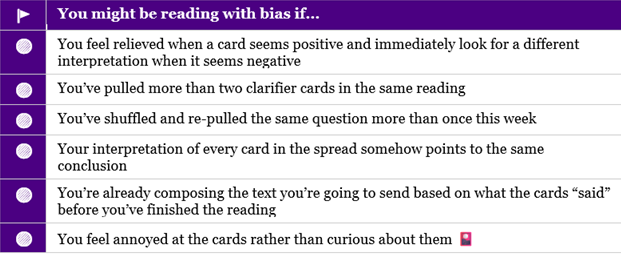
🚩 Signs You Might Be Reading With Bias Right Now
Sometimes it’s hard to know in the moment. Here are some honest warning signs to watch for:
🌙 When to Put the Cards Down
Sometimes the most powerful tarot practice is knowing when not to read. Here are a few situations where it’s genuinely worth waiting:
- In the first 24 hours after a shock, breakup, or major upset. Your nervous system is overwhelmed. The reading will reflect your panic, not the truth.
- When you’ve already decided what you’re going to do. If you’re reading hoping the cards will validate a decision you’ve already made, be honest with yourself. You don’t need tarot. You need permission. Give it to yourself instead.
- When you’re reading the same question for the fifth time this week. The cards have already told you. The issue isn’t the reading — it’s that you’re struggling to accept the answer. That struggle deserves attention, not more cards. 🎴
This isn’t failure. This is wisdom. Knowing your limits as your own reader is a sign of a mature practice. ✨
📓 Reflection Prompts
Sit with these honestly. They’re not comfortable questions — but that’s the point. 🎴🌙
- Can I think of a reading I did for myself where I know, honestly, that I interpreted the cards to fit what I wanted to hear? What was I hoping to avoid seeing?
- Which of the seven strategies feels most useful for how I tend to self-read? Which one feels most uncomfortable — and why?
- Is there a question I’ve been asking the cards repeatedly? What might that repetition be telling me about what I actually need right now?
- When I read for myself, am I seeking clarity — or am I seeking permission? What’s the difference for me?
- What would it feel like to trust a reading that told me something I didn’t want to hear? 🎴✨
🎴 Try This Right Now
Here’s a short practice to try the next time you sit down for a self-reading. It takes about five extra minutes and it will change the quality of your readings completely. 🌙✨
📋 The Honest Reader Protocol
1. Ground yourself. Three slow breaths. Feet on the floor.
2. Write down: What do I hope this reading says? What am I afraid it will say?
3. Commit out loud: “I agree to read what is here, not what I want to be here.”
4. Shuffle slowly. Pull your card(s). Flip and describe the image before connecting to your question.
5. Pretend for a moment you’re reading for your best friend. What would you tell her?
6. Journal the reading fully — cards, positions, impressions, interpretation, emotional response.
7. Walk away for at least an hour before acting on anything the reading revealed. 🎴✨
✨ A Note From Me to You
Reading for yourself without bias is one of the hardest skills in tarot. Not because the cards are complicated. Because you are wonderfully, beautifully, irreducibly human — and humans want things. We hope. We fear. We ache for particular answers.
Your desire for a certain outcome isn’t a flaw in your reading practice. It’s evidence that your life matters to you. That you care about what happens. That you’re paying attention.
The work isn’t to eliminate that caring. It’s to read alongside it, honestly, with enough space between your hopes and your interpretation to let the truth come through. 🎴
Keep reading, Magickal One. Even the biased readings teach you something. 🌙✨
Your Sister in Spirit,
A Pinch of Magick 🌙✨
🎴 Free Printable: The Honest Reader Checklist 🎴
I made you something! 🎁
Download your free Honest Reader Checklist printable — a beautiful one-page reference sheet with all seven bias-busting strategies, the Honest Reader Protocol, warning sign reminders, and space to track your own self-reading patterns. Keep it with your deck. 🎴📓✨
💜 Want to go even deeper?
Paid subscribers get the Module 11 companion post this Wednesday — Reading Through the Hard Cards: What to Do When the Tower, the Devil, or the Ten of Swords Shows Up in a Self-Reading. Because sometimes the cards you most want to avoid are the ones with the most important message. 🎴💜
💬 Leave a Comment
Have you ever caught yourself reading with bias? Which of the seven strategies are you going to try? Drop a comment — this is one of my favourite conversations to have with this community. 🎴🌙
📩 Send a Message
Have a self-reading you’re not sure how to interpret? A question about tarot bias? My messages are open. 🔮✨
🔗 Share This Post
Know a tarot reader who’s been struggling with self-readings? This one’s for them. Share the love. 🎴💜
🌙 Explore More Magick 🌙
I create digital guides, rituals, merch, and intentional living tools inspired by witchcraft, lunar wisdom, self-care, intuition, and soulful living.
If you’d like to explore more of what I offer, you can find my growing collection of magickal digital creations here:
✨ A Pinch of Magick — Etsy Shop 👉
Thank you for supporting independent, heart-led magic. 💜

This was so great, thank you!